




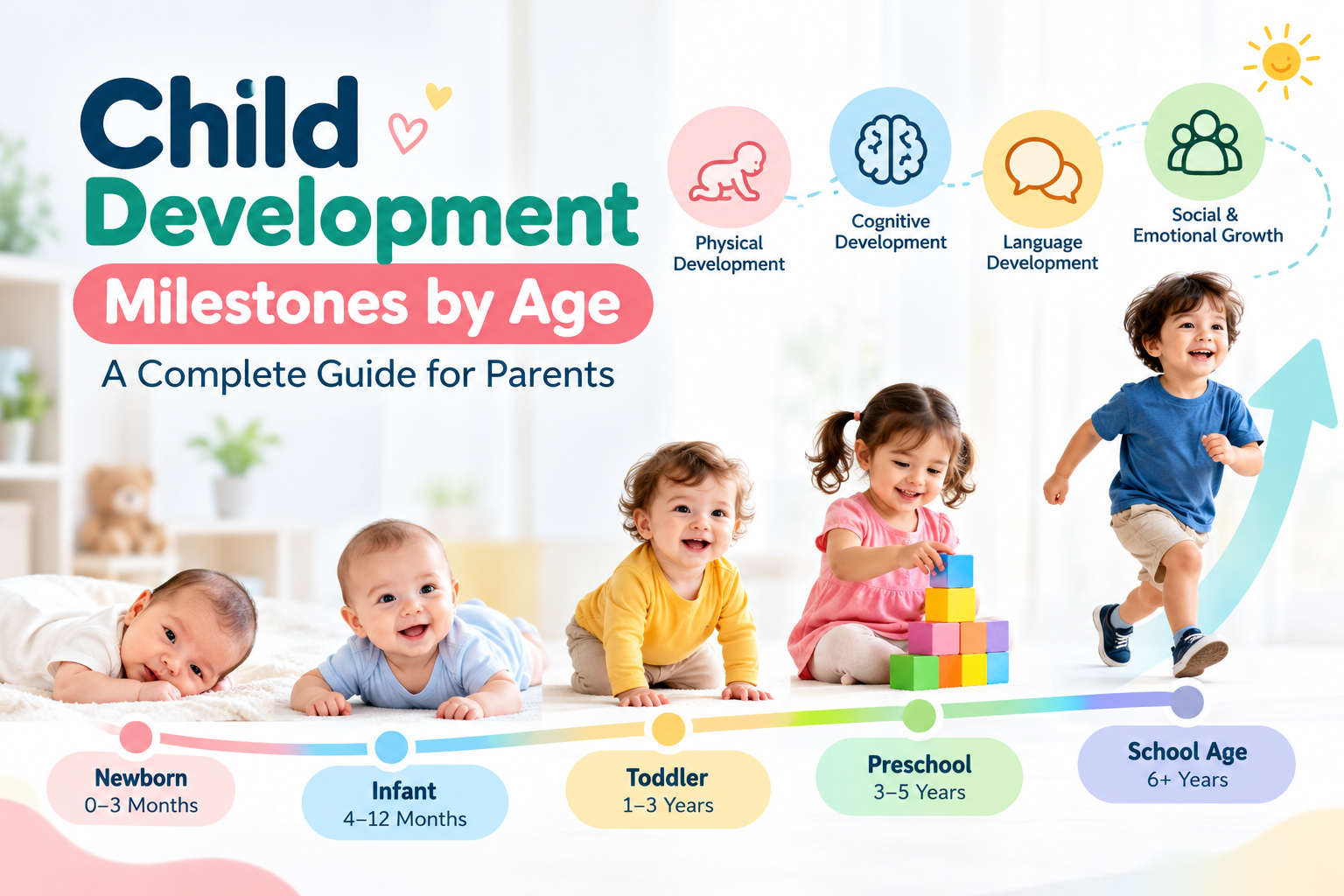
Child Development Milestones by Age (0–5 Years): Skills, Screening and When to Seek Help
A healthcare-focused guide for Indian parents to understand child development milestones from infancy to preschool. Learn what skills to observe, how developmental monitoring and screening differ, what to record before a visit, and when to ask a pediatrician for an assessment.
What Do Child Development Milestones Tell Us?
Child development involves movement, communication, learning, relationships and emotional regulation. Examples include smiling, babbling, sitting, gestures, word combinations, pretend play and taking turns. These skills help caregivers and healthcare professionals structure observations and identify questions for a clinical visit.
The Centers for Disease Control and Prevention (CDC) provides milestone checklists covering ages from two months through five years. The listed skills are those most children, approximately 75% or more, can do by the listed age. They can prompt a conversation, but they do not diagnose or label a child.
Consult the CDC developmental milestones resource alongside professional care.
In India, the Ministry of Women and Child Development has published the Navchetna framework for early-childhood stimulation from birth to three years and Aadharshila for children aged three to six. These frameworks emphasise holistic development and responsive caregiving. Explore the Ministry’s Early Childhood Care and Education resources.
Developmental Milestones by Age: Birth to 5 Years
Use this overview to prepare for routine visits. It focuses on representative skills rather than attempting to test every ability. Development may be influenced by health, opportunities to practise, hearing and vision, and whether a child was born prematurely.
Birth to 3 Months: Early Regulation and Social Connection
Babies gradually develop steadier head control during awake, supervised tummy time, move both arms and legs, briefly open their hands, look at faces and respond to sounds. Many begin smiling in response to people and making sounds other than crying.
What to observe: Responses to voices and everyday sounds, visual attention to faces, movement on both sides and emerging social responses. Place babies on their backs for sleep; tummy time is only for awake, closely supervised periods.
4–6 Months: Motor Control and Social Vocalisation
Many babies hold their head more steadily, reach for toys, bring objects to the mouth, laugh, squeal and exchange sounds with caregivers. Some roll, push up on their forearms or begin sitting with support.
What to observe: Whether the baby reaches and explores, reacts to voices, makes back-and-forth sounds and uses both sides of the body. Raise any hearing, vision or movement concerns with a clinician.
7–9 Months: Sitting, Babbling and Interactive Play
Many infants sit without support, pass objects between hands, bang toys together, babble repeated syllables and look towards familiar people or their name. They may enjoy peekaboo. Crawling styles and timing vary.
What to observe: Progress in sitting and object exploration, vocal turn-taking, response to familiar communication and interest in people. Note any asymmetry or loss of a previously present skill.
10–12 Months: Gestures, Shared Attention and Pulling to Stand
A child may pull to stand, cruise along furniture, wave, use early words such as “mama” or “dada” for a person, imitate games and put objects into containers. Gestures and attempts to share interest are important communication behaviours. Walking does not have to begin exactly on the first birthday.
What to observe: Gestures, shared attention, attempts to communicate needs, motor progress and play.
13–18 Months: Independent Exploration and Early Words
Many toddlers begin walking independently, point to show interest, imitate household actions, follow familiar one-step requests with context, try using a spoon and attempt words beyond the earliest parent names. Communication includes gestures, sounds, eye gaze and words—not vocabulary alone.
What to observe: How the toddler requests, shares attention, understands simple language, moves around and copies actions. Persistent concerns may justify developmental review.
19–24 Months: Word Combinations and Pretend Play
By about age two, many children put two words together, point to pictures or body parts when asked, run, kick a ball and use familiar items in pretend play. They may express preferences more strongly than they can manage frustration.
Word counts vary, but persistent communication concerns should not be dismissed as “just late talking.”
What to observe: Whether the child communicates spontaneously, combines words, understands familiar requests, imitates play and continues gaining skills. Ask a clinician whether hearing assessment or speech-language evaluation is appropriate.
2–3 Years: Language Growth, Movement and Symbolic Play
During this period, many children combine more words, learn action words, follow simple directions, run, climb, use utensils and engage in pretend play. Near 30 months, many use around 50 words and combine words, but clinicians consider the whole communication picture rather than relying on a single count.
What to observe: Understanding, expression, imitation, play flexibility, movement and how the child responds to others. Ask about screening if skills are not progressing.
3–4 Years: Conversation and Expanding Social Skills
Many three-year-olds take part in back-and-forth conversations, ask who, what, where and why questions, are understood by others much of the time and join other children in play. By four, children often tell something that happened during their day, answer simple questions, name some colours, play imaginative roles and catch a large ball some of the time.
What to observe: Whether speech is becoming more understandable, the child can share a basic experience, participate in play and manage everyday routines with age-appropriate help. Discuss persistent difficulties in language, interaction, hearing or motor coordination.
4–5 Years: Complex Play and Preparation for School
Many children nearing five follow rules or take turns in simple games, tell a story with at least two events, answer questions about a story, recognise simple rhymes, write or copy some letters and hop on one foot.
These are examples, not a school-entry exam. Self-regulation and independence are still developing.
What to observe: Communication across everyday settings, peer interaction, ability to learn through play, self-care and any concern reported by preschool or family.
Five Areas of Development Clinicians Consider
These areas overlap. Hearing affects access to spoken language, and play supports movement, attention and communication. Assessment should consider a child’s strengths and family, cultural and linguistic context.
Developmental Monitoring, Screening and Assessment: What’s the Difference?
Monitoring or surveillance is the ongoing process of asking about development, observing a child and listening to family concerns during health visits.
Developmental screening uses a standardised, validated tool to look more systematically at whether a child may need further evaluation.
Diagnostic assessment is a deeper professional evaluation used to understand a child’s abilities and whether a developmental condition is present.
A checklist downloaded from the internet is not a substitute for validated screening or diagnostic assessment. In the United States, the American Academy of Pediatrics describes routine standardised developmental screening at 9, 18 and 30 months and autism-specific screening at 18 and 24 months, as well as assessment whenever a concern arises.
In India, ask your pediatrician which tools and timing are appropriate. The American Academy of Pediatrics milestone resource and CDC checklist are useful conversation starters.
Warning Signs: When to Seek Advice
Arrange a review if your child is not progressing in one or more areas, has ongoing difficulty using or understanding communication, seems not to respond to sound, struggles with visual attention, shows persistent unusual stiffness or floppiness, uses one side much less than the other, or you have a concern that affects daily life.
Regression—the loss of words, movement, interaction or another skill the child previously had—needs prompt medical evaluation. Sudden weakness, seizures, reduced consciousness or another acute change requires urgent or emergency care.
Before the appointment, note the child’s age and birth history, languages used at home, skills you have observed, situations in which concerns occur and whether abilities are changing. Ask preschool or caregivers for examples where relevant.
Depending on findings, a pediatrician may suggest hearing or vision checks, speech-language assessment, developmental evaluation or early-support services. The pathway depends on local availability. Families can ask for support before a definitive diagnosis.
How Parents Can Support Development at Home
The World Health Organization’s Nurturing Care Framework emphasises good health and nutrition, safety and security, responsive caregiving and opportunities for early learning. Daily routines can include warm responses, back-and-forth games, reading, singing, safe movement and age-appropriate independence.
- Use familiar languages: Communicate in the language or languages your family speaks comfortably. Explain the language environment during an assessment.
- Make play interactive: Pause after speaking, wait for a gesture or sound, imitate it and add a word or idea.
- Offer safe practice: Provide age-appropriate toys and household objects, and supervise to prevent choking, falls and other injuries.
- Keep routines predictable: Build in sleep, meals, movement and connection. Ask a healthcare professional about feeding, growth or sleep concerns.
- Avoid comparison and blame: Development is influenced by many factors. A concern is a reason to seek support, not a parenting failure.
For the Indian early-years context, the Ministry of Women and Child Development’s Early Childhood Care and Education resources describe approaches to early stimulation and foundational learning. WHO’s Nurturing Care for Early Childhood Development provides broader public-health guidance.
Frequently Asked Questions
Are developmental milestones exact deadlines?
No. They support observation and discussion. One absent skill does not diagnose a delay, but patterns of concern or loss of a skill should be discussed with a clinician.
Does late talking always mean autism?
No. Communication differences can have different causes, including hearing or language-development differences. A clinician assesses the whole developmental picture.
Can a child who speaks two or three languages be slower to talk?
Exposure to multiple languages does not itself cause a language disorder. Describe communication across all languages and seek assessment if concerns persist.
What should I bring to a pediatric appointment?
Bring examples of skills, any lost skills, birth and medical history, hearing or vision concerns, home languages and preschool feedback.
Should I wait until the next routine check-up if I am worried?
No. Contact your child’s healthcare professional when a concern arises, particularly if a previously acquired skill has been lost. Ask whether screening, assessment or referral is appropriate.
Medical disclaimer: This article is for general information and is not a substitute for individual clinical advice. Pediatrician review is pending. Do not label it medically reviewed until a qualified reviewer has checked and approved the content. For concerns about a specific child, seek professional assessment.
