



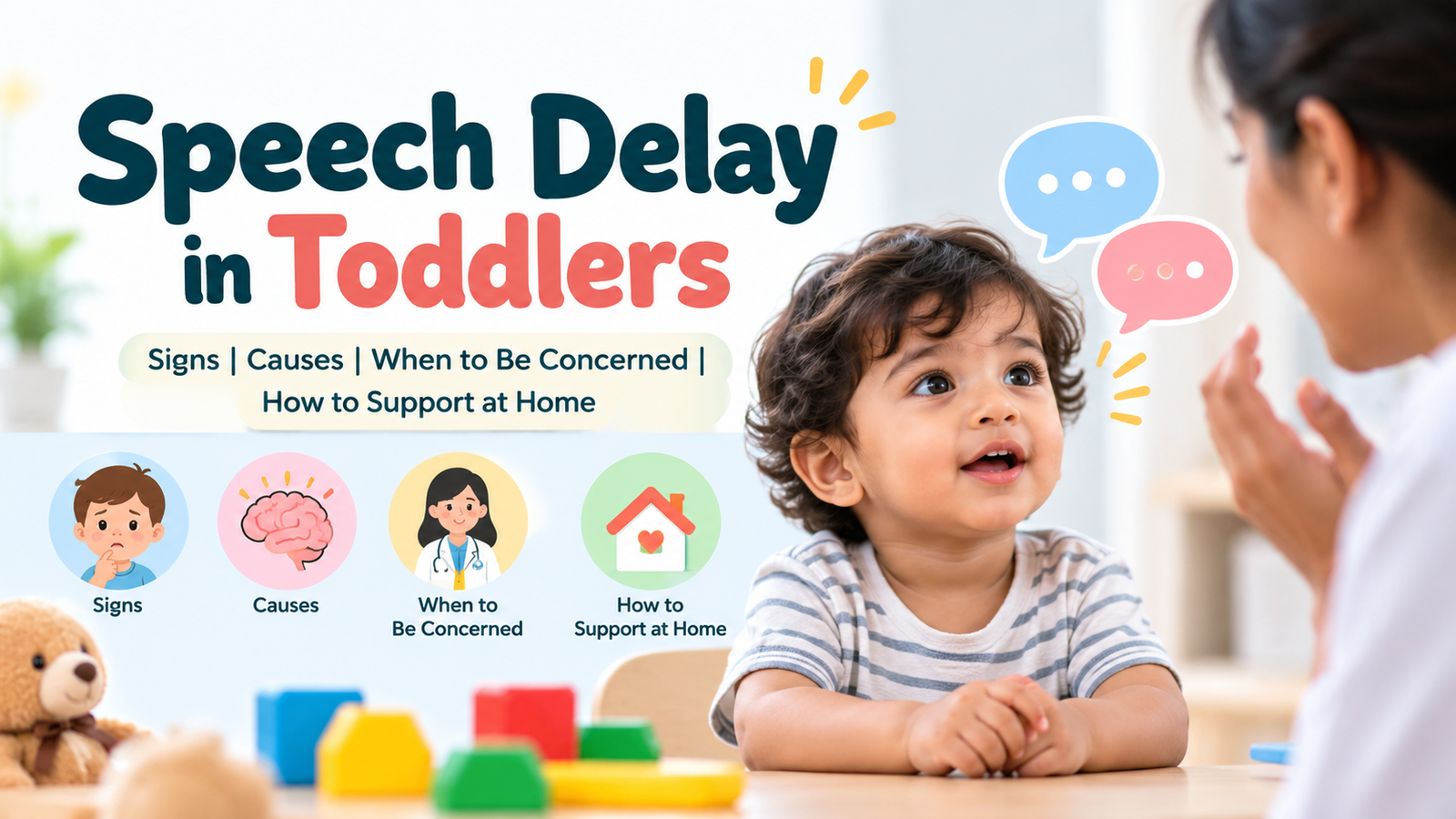
Speech Delay in Toddlers: Signs, Causes and Assessment
Is your toddler talking less than other children of the same age? Learn the common signs of speech and language delay, developmental milestones to watch, how hearing and speech-language assessments work, and when Indian parents should seek professional advice.
What Is Speech Delay in Toddlers?
Speech delay in toddlers refers to speech skills that are developing more slowly than expected for a child’s age. Parents may notice that their toddler uses very few words, is difficult to understand or struggles to combine words. Sometimes the concern involves language development as well as speech.
Speech and language are related, but they are not the same. Speech involves producing sounds and words. Language involves understanding messages and expressing meaning through words, gestures, signs or other communication methods.
A child may understand what family members say but use few spoken words. Another child may speak frequently but have difficulty understanding instructions or communicating needs. A speech-language professional assesses these skills separately because the distinction can influence the next steps.
A toddler who talks later than expected is sometimes described as a “late talker.” This description does not provide a diagnosis or reliably predict an individual child’s future development. Assessment considers communication, comprehension, gestures, play, social interaction, hearing and general development together.
Parents should avoid diagnosing speech delay based on a single behaviour or comparing their child with a sibling. Instead, notice how communication changes over time and discuss persistent concerns with a qualified professional.
Signs of Speech Delay in Toddlers by Age
Developmental milestones are useful reference points, not diagnostic tests. The following examples can help you decide what to discuss with your child’s healthcare professional.
12–18 Months: Early Words and Gestures
During this period, children develop ways to request, share attention and communicate with familiar people. They may use gestures, point, imitate sounds, understand familiar words and begin speaking meaningful words.
Consider discussing these concerns:
- Your child rarely uses gestures to communicate, such as pointing or waving.
- Your child does not seem to understand familiar words or simple requests.
- Your child has very few attempts at meaningful communication or does not appear to respond to sounds.
Around 18 months, many children use a small number of meaningful words beyond names for their parents and can follow familiar one-step directions. If these skills are not emerging, discuss your concerns with your child’s doctor.
18–24 Months: Vocabulary and Combining Words
Toddlers commonly build their vocabulary and begin using words to request things, name objects and communicate experiences. They may also follow familiar directions, point to pictures and use gestures alongside spoken words.
Possible concerns include:
- Your child uses very few meaningful words or is not gaining words over time.
- Your child has difficulty understanding familiar words or requests.
- Your child rarely uses gestures, sounds or words to communicate needs.
- Your child is not beginning to combine words around the expected age.
By around two years, many children begin putting two words together, such as “more milk.” They also increasingly use gestures, point to familiar objects and communicate wants and interests.
A toddler who is not combining words, or whose communication raises concerns, should be discussed with a healthcare professional rather than being assessed solely by comparing them with another child.
2–3 Years: Growing Language and Everyday Conversation
Between two and three years, children typically develop longer combinations of words and become more effective at communicating about familiar activities, people and objects. Their speech gradually becomes easier for familiar adults to understand.
Discuss an assessment if:
- Your child continues to use very few words or rarely combines words.
- Your child struggles to understand simple, familiar instructions.
- Your child has difficulty communicating basic needs even with gestures and other supports.
- Your child has stopped using words or other communication skills they previously had.
These are reasons to seek advice, not proof of a particular condition. A clinician will consider the child’s full developmental and medical history and determine whether a hearing test, speech-language evaluation or broader developmental assessment is needed.
What Causes Speech or Language Delay in Toddlers?
Speech and language differences can have several explanations. A checklist alone cannot establish the cause, and the same sign may appear in children with different developmental profiles.
Other factors in the child’s medical and developmental history may also matter. Recurrent ear infections, prematurity, family history of speech or language difficulties and the child’s communication environment may be relevant information during assessment.
Being exposed to two or more languages does not, by itself, cause a speech or language disorder. Nor should parents assume that a child will automatically catch up without support. The appropriate next step depends on the child’s individual skills and needs.
How Is Speech Delay Assessed?
Speech delay assessment usually starts with a conversation with a pediatrician or other qualified child-health professional. Depending on the findings and local services, the child may also need an audiologist, speech-language therapist or developmental specialist.
1. Developmental and Medical History
The healthcare professional may ask when your child began babbling, using gestures and saying words; what they understand; how they communicate needs; and whether they have lost any skills. Birth history, medical conditions, ear infections and family history can also be relevant.
Tell the clinician which languages your child hears and uses at home, with relatives and at preschool. Examples of communication during ordinary routines can be more informative than a parent’s estimate of word count alone.
2. Hearing Assessment
Hearing assessment is an important part of evaluating a toddler with speech or language concerns. Responding to music, loud noises or a parent’s voice does not rule out every hearing difficulty.
A clinician may recommend an age-appropriate hearing test with an audiologist. The type of test depends on the child’s age, ability to participate and clinical history.
3. Speech and Language Evaluation
A speech-language therapist or pathologist may evaluate how your child understands language, uses words, communicates through gestures and sounds, produces speech, plays and interacts with others.
The assessment may include play-based observation, parent interviews, language samples and suitable screening or assessment tools. The professional should consider the child’s age, languages, cultural context and everyday communication.
4. Broader Developmental Assessment When Needed
If communication concerns occur alongside differences in social interaction, play, movement or other developmental skills, the clinician may recommend a broader developmental evaluation. This helps identify a child’s strengths and support needs rather than focusing on speech alone.
Assessment findings can lead to different recommendations: guidance for parents, periodic monitoring, a hearing referral, speech-language support or evaluation by other specialists. There is no single plan that is right for every toddler.
Does Growing Up With Multiple Languages Cause Speech Delay?
No. Learning languages such as Kannada, Telugu, Tamil, Hindi or English does not, by itself, cause a speech or language disorder. Many children grow up hearing and using more than one language.
When assessing a multilingual child, the professional should ask which languages the child understands and uses, how much exposure they have had to each language, and how they communicate with different people.
Parents should share meaningful words and phrases used across all the child’s languages. A child may use one language with a grandparent and another at preschool. Considering only one language can give an incomplete picture of communication skills.
Do not stop speaking your family’s languages solely because you are worried about speech delay. Use the languages in which you can communicate naturally and responsively, and ask a qualified professional to assess the child’s complete language environment.
How Parents Can Support Speech and Language Development at Home
Everyday interaction gives toddlers opportunities to listen, respond, practise gestures and learn new words. These ideas can support communication, but they do not replace an assessment or recommended therapy.
- Talk during daily routines: Describe what you are doing while bathing, dressing, eating or playing. Use short, clear phrases that fit your child’s level.
- Follow your child’s interests: If your toddler points to a ball, say “Yes, ball” or “Roll the ball.” Responding to what interests the child makes communication purposeful.
- Read picture books together: Name pictures, pause, point and give your toddler time to respond. You do not need to read every word on the page.
- Sing and play: Familiar songs, action rhymes, simple pretend play and turn-taking games create natural opportunities to practise communication.
- Accept gestures and attempts: Respond to pointing, facial expressions, sounds and attempts at words. Model the word without forcing your child to repeat it.
- Expand what your child says: If your toddler says “car,” you might respond, “Yes, a blue car.” Keep your response natural and avoid turning every interaction into a test.
- Make time for interaction: Prioritise face-to-face play and conversation. Avoid allowing screens to routinely replace responsive communication with adults.
If a professional recommends speech-language therapy, ask which activities to practise at home and how to include them in your normal routines.
When Should You Consult a Pediatrician or Speech Therapist?
Arrange an appointment if your toddler is not meeting communication milestones, is using very few words, has difficulty understanding familiar language, is not beginning to combine words around the expected age, or you have an ongoing concern about communication.
Loss of words, gestures, social interaction or other developmental abilities should not be dismissed as a temporary phase. Sudden weakness, seizures, reduced consciousness or another acute neurological change requires urgent medical care.
You do not need to wait until your child reaches a particular birthday or until you are certain there is a problem. Early evaluation can help clarify what is happening and whether support is appropriate.
Before the visit, note your child’s words and gestures, what they understand, the languages they use, any hearing concerns and whether skills have changed. You can also ask the preschool or other regular caregivers what they have observed.
If your concerns remain unresolved after a first appointment, ask for an explanation of the assessment findings or whether referral for a second opinion is appropriate.
Frequently Asked Questions About Speech Delay in Toddlers
What are the common signs of speech delay in toddlers?
Signs may include very few meaningful words, limited progress in vocabulary, difficulty combining words, difficulty understanding familiar language or reduced use of gestures to communicate. The significance of a sign depends on the child’s age and overall development.
Is speech delay in a two-year-old always a serious problem?
Not every child who speaks later has a lasting disorder, but persistent concerns deserve assessment. At age two, many children begin putting two words together. Discuss concerns with your child’s pediatrician instead of relying on comparison alone.
Can too much screen time cause speech delay?
Screen use may displace the live interaction, conversation and play through which young children learn. It is not possible to determine the cause of an individual child’s communication difficulty from screen habits alone. Discuss your child’s development with a professional.
Should I stop speaking my home language if my toddler is not talking?
No. Learning more than one language does not, by itself, cause a speech or language disorder. Tell the assessor about every language your child hears and uses so their communication can be considered appropriately.
Does a toddler with speech delay need a hearing test?
A hearing assessment is commonly an important part of evaluating speech and language concerns. Your pediatrician can guide you to an audiologist and an age-appropriate test.
Can a speech delay improve without therapy?
Some children make progress with monitoring and supportive communication at home, while others benefit from targeted speech-language services. The appropriate plan depends on the child’s assessment, developmental profile and progress.
Concerned About Your Toddler’s Speech Development?
Talk with a qualified pediatrician or speech-language professional about your child’s communication. An assessment can help clarify the next steps and identify support suited to your child’s needs.
Contact Heal Vista Blog for more information about this article.
This article is for general education and does not replace individual medical advice. Contact details can be added to this section when ready for publication.
Medical Disclaimer
This article is for general educational purposes and does not diagnose or treat speech or language disorders. Pediatrician review is pending. Developmental milestones are guides, not diagnostic tests. Consult a qualified healthcare professional about concerns regarding a specific child.
