




Irregular Periods: Causes, Symptoms, Treatment & When to See a Doctor
Irregular periods can happen for many reasons, from stress and hormonal changes to PCOS, thyroid problems and changes in weight. Learn what irregular periods mean, what may cause them and when you should speak with a doctor.
Medical note: This article is intended for general educational purposes only. It is not a substitute for professional medical advice, diagnosis or treatment.
Periods do not always arrive on exactly the same day every month. A menstrual cycle can occasionally be earlier, later, lighter or heavier than usual. However, when your menstrual pattern changes repeatedly, it is worth paying attention.
Irregular periods can happen for many reasons, including stress, pregnancy, changes in weight, intense exercise, hormonal contraception, polycystic ovary syndrome (PCOS), thyroid problems and the natural hormonal changes that occur during puberty and the years leading up to menopause.
For some people, irregular periods are temporary. For others, they may be a sign of an underlying health condition that needs medical evaluation and treatment.
This guide explains what irregular periods mean, common causes, symptoms to watch for, possible treatment options and when it is important to speak with a doctor.
What Are Irregular Periods?
Your menstrual cycle is counted from the first day of one period to the first day of the next.
There is no single cycle length that is perfect for everyone. Many adults have cycles of around 21 to 35 days, although individual patterns can vary. The important thing is to understand what is normal for you and notice significant changes.
You may have irregular periods if:
- Your periods frequently come much earlier or later than expected.
- The number of days between periods changes considerably.
- You sometimes skip a period.
- Your bleeding suddenly becomes much heavier or lighter.
- Your periods last longer than usual.
- You experience bleeding between periods.
- Your previously regular periods become irregular.
A single late period does not necessarily mean that something is wrong. However, a persistent or sudden change in your menstrual pattern deserves attention.
Common Causes of Irregular Periods
There are many possible causes of irregular periods. Sometimes, more than one factor can affect the menstrual cycle at the same time.
1. Pregnancy
If you are sexually active and your period is late or missing, pregnancy should be considered.
A missed period can be one of the earliest signs of pregnancy. Even people who usually have irregular cycles can become pregnant because ovulation may occur unpredictably.
If pregnancy is possible, a home pregnancy test can be a useful first step. If the result is negative but your period remains absent, speak with a healthcare professional.
2. Polycystic Ovary Syndrome (PCOS)
PCOS is a common hormonal condition that can affect ovulation and menstrual cycles.
People with PCOS may experience:
- Irregular or infrequent periods
- Acne
- Increased facial or body hair
- Weight changes
- Difficulty becoming pregnant
Not everyone with PCOS has all of these symptoms.
If irregular periods occur together with acne, increased facial hair, unexplained weight changes or difficulty conceiving, a doctor may consider PCOS as one possible cause.
PCOS and Pregnancy: Can You Get Pregnant With PCOS?
3. Thyroid Problems
The thyroid gland produces hormones that influence many functions in the body. Both an underactive thyroid and an overactive thyroid can affect menstruation.
Depending on the thyroid condition, you may also experience:
- Tiredness
- Weight changes
- Changes in mood
- Feeling unusually cold or hot
- Changes in heart rate
- Hair or skin changes
If menstrual changes occur together with other symptoms of thyroid disease, your doctor may recommend thyroid testing.
4. Stress
Long-lasting or significant stress can interfere with the hormonal signals involved in ovulation.
This can sometimes result in:
- A late period
- A missed period
- Longer gaps between periods
- Temporary changes in menstrual flow
Stress-related menstrual changes may improve when the underlying stress is reduced. However, persistent irregularity should not automatically be blamed on stress. Other causes may need to be ruled out.
5. Sudden Weight Loss or Weight Gain
Significant changes in body weight can affect hormone production and ovulation.
Very restrictive diets, inadequate calorie intake and substantial weight loss can interfere with the menstrual cycle. Changes in body weight can also be associated with menstrual irregularities.
Rather than focusing only on the number on the weighing scale, consider whether your eating pattern, weight or exercise routine has changed significantly in recent months.
6. Excessive Exercise
Regular physical activity is beneficial for health. However, very intense exercise combined with inadequate nutrition can sometimes disrupt the hormones responsible for menstruation.
This may happen in people involved in endurance sports, intensive training or activities requiring very high levels of physical exertion.
If your periods become very infrequent or stop after a major increase in exercise, discuss the change with a healthcare professional.
7. Hormonal Contraception
Hormonal contraceptives can change the pattern of menstrual bleeding.
Depending on the method, you may experience:
- Lighter periods
- Irregular bleeding
- Spotting
- Fewer periods
- No periods
Examples include some contraceptive pills, injections, implants and hormonal intrauterine devices.
These changes can be expected with some contraceptive methods. However, new or unusually heavy bleeding should still be discussed with your healthcare provider.
8. Puberty
Irregular periods are common during the first few years after menstruation begins.
The hormonal system that controls ovulation is still developing, so cycles may not follow a predictable pattern.
This does not mean every irregular period in a teenager should be ignored. Very heavy bleeding, severe pain, prolonged absence of periods or symptoms affecting daily life should be evaluated.
9. Perimenopause
As menopause approaches, hormone levels naturally change.
This transition, called perimenopause, can cause periods to become:
- More frequent
- Less frequent
- Heavier
- Lighter
- Longer
- Shorter
Perimenopause commonly occurs in the 40s and can continue for several years before menopause.
If menstrual changes occur much earlier than expected, medical evaluation can help identify other possible causes.
10. Other Medical Conditions
Irregular or abnormal menstrual bleeding can sometimes be associated with conditions affecting the reproductive organs.
Examples include:
- Uterine fibroids
- Uterine polyps
- Pelvic inflammatory disease
- Adenomyosis
- Problems affecting ovarian function
- Certain hormonal disorders
Some of these conditions can also cause pelvic pain, heavy bleeding or bleeding between periods.
Symptoms You May Notice
The symptoms depend on the underlying cause.
You may notice:
- Periods arriving earlier than expected
- Periods arriving later than expected
- Skipped periods
- Heavy menstrual bleeding
- Very light bleeding
- Bleeding between periods
- Periods lasting longer than usual
- Pelvic pain
- Acne
- Increased facial or body hair
- Weight changes
- Fatigue
- Difficulty becoming pregnant
The combination of symptoms can provide useful clues to a doctor.
For example, irregular periods accompanied by increased facial hair and acne may prompt evaluation for a hormonal condition such as PCOS. On the other hand, irregular periods accompanied by significant weight loss and intense exercise may suggest a different cause.
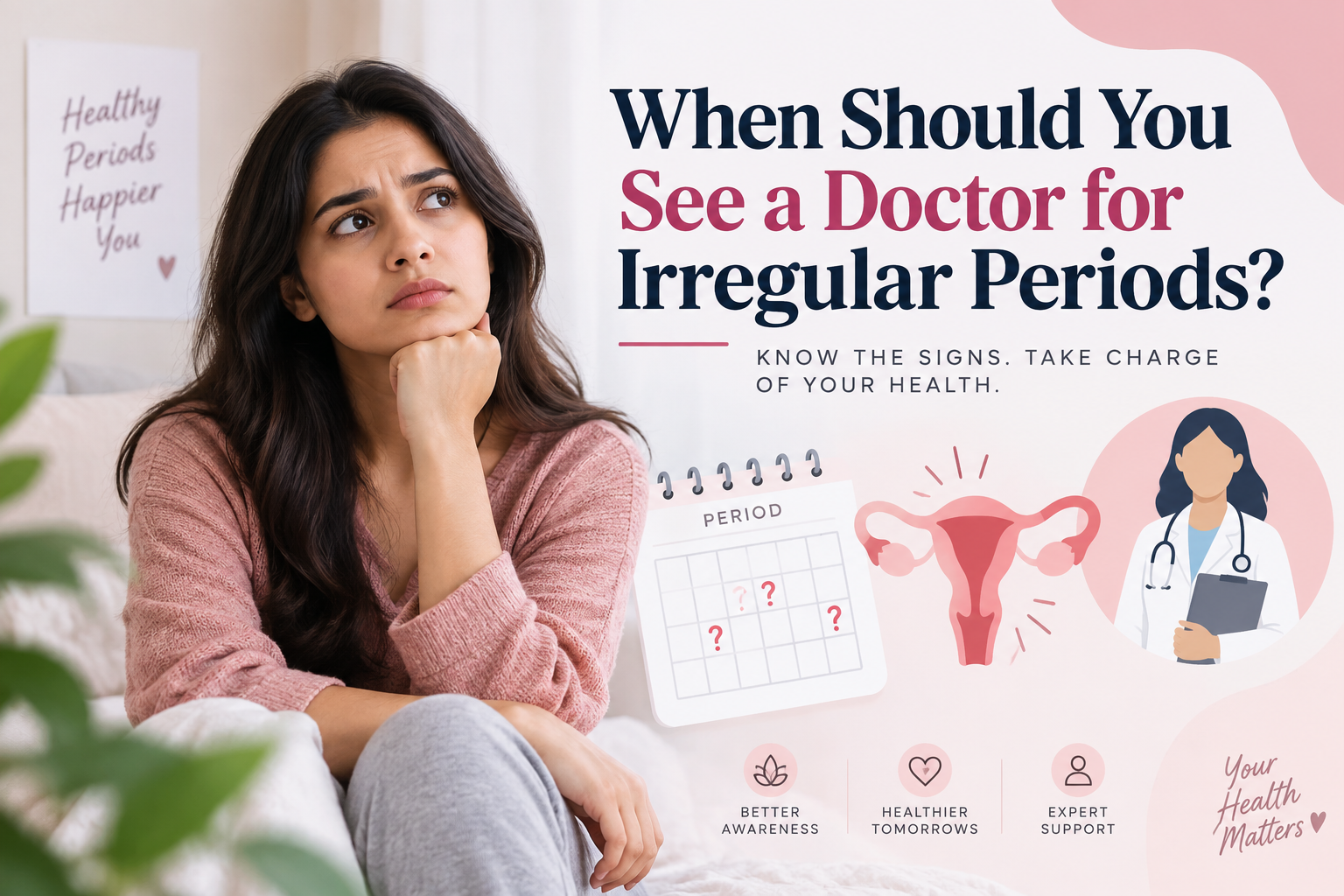
When Should You See a Doctor for Irregular Periods?
You do not necessarily need to worry if your period is a few days late. Menstrual cycles can vary from month to month.
However, make an appointment with a doctor if your menstrual pattern repeatedly changes or you are concerned about it.
Medical advice is particularly important if:
- Your previously regular periods become irregular.
- You repeatedly miss periods.
- You have not had a period for several months.
- You bleed between periods.
- Your periods last longer than usual.
- Your bleeding is significantly heavier than normal.
- You have severe or worsening pelvic pain.
- You have irregular periods and are trying to become pregnant.
- You have irregular periods together with unexplained weight changes, acne or increased facial hair.
- You develop symptoms suggesting a thyroid or other hormonal problem.
When Is Heavy Period Bleeding an Emergency?
Very heavy bleeding should not be ignored.
Seek urgent medical attention if:
Your bleeding is severe, particularly if you are soaking through pads or tampons very frequently, feeling faint or weak, or experiencing symptoms that may indicate significant blood loss.
If you are pregnant or pregnancy is possible and you have significant bleeding or severe abdominal or pelvic pain, seek urgent medical care.
How Are Irregular Periods Diagnosed?
A doctor will usually start by asking about your menstrual history and other symptoms.
You may be asked:
- When was your last period?
- How long are your cycles usually?
- How many days does your bleeding last?
- How heavy is the bleeding?
- Have you missed any periods?
- Are you sexually active?
- Could you be pregnant?
- Have you recently gained or lost weight?
- Have you changed your exercise routine?
- Are you taking medicines or hormonal contraception?
- Do you have acne or increased facial hair?
- Are you experiencing pelvic pain?
- Do you have symptoms of thyroid problems?
Depending on your symptoms, your healthcare provider may recommend tests.
These can include a pregnancy test, blood tests for hormones or thyroid function, and sometimes pelvic imaging such as an ultrasound.
The tests needed depend on your age, symptoms, medical history and suspected cause.
How Are Irregular Periods Treated?
There is no single treatment for irregular periods.
Treatment depends on the underlying cause.
If PCOS Is Involved
Treatment may focus on managing symptoms, supporting metabolic health when appropriate, regulating bleeding and addressing fertility goals.
If Thyroid Disease Is Involved
Treatment of the thyroid condition may help improve menstrual regularity.
If Contraception Is Causing the Change
Your doctor may discuss whether your current contraceptive method is appropriate or whether another option may suit you better.
If Stress, Inadequate Nutrition or Excessive Exercise Is Contributing
Improving nutrition, reducing excessive training and addressing significant stress may help restore normal menstrual function.
If a Structural Problem Is Present
Conditions such as fibroids or polyps may require specific medical or surgical treatment depending on their size, location and symptoms.
Hormonal medicines may sometimes be prescribed to regulate bleeding, but they should be used based on your individual medical history and the advice of a qualified healthcare professional.
Can Irregular Periods Affect Pregnancy?
They can sometimes make pregnancy more difficult, particularly when irregular periods are caused by irregular or absent ovulation.
If ovulation does not happen regularly, predicting the fertile window can be more difficult.
However, irregular periods do not automatically mean infertility.
Many people with irregular cycles can become pregnant, depending on the underlying cause.
If you are trying to conceive and your periods are consistently irregular, speaking with an obstetrician-gynaecologist or fertility specialist can help determine whether you are ovulating and whether another condition needs treatment.
How Can You Track Your Periods?
Tracking your menstrual cycle is one of the simplest things you can do.
Record:
- First day of each period
- Last day of bleeding
- Approximate flow
- Spotting between periods
- Pain or cramps
- Other symptoms
- Major changes in weight, diet or exercise
- Medicines or contraception
- Pregnancy-test results when relevant
You can use a calendar, notebook or period-tracking app.
Tracking your cycle for several months can help you and your doctor identify patterns and changes.
Can Irregular Periods Be Prevented?
Not every cause of irregular periods can be prevented.
However, supporting your overall health may help maintain a healthy menstrual cycle.
Helpful habits include:
- Eat a balanced diet.
- Avoid extreme dieting.
- Maintain a healthy and sustainable exercise routine.
- Get adequate sleep.
- Find practical ways to manage ongoing stress.
- Take medicines only as directed.
- Attend recommended health checkups.
- Track menstrual changes.
- Seek medical advice when your usual pattern changes significantly.
Most importantly, do not assume that every menstrual change is caused by stress, food or lifestyle. Persistent changes deserve proper medical evaluation.
Frequently Asked Questions
Is it normal to have irregular periods?
Occasional variation can happen, particularly during puberty, pregnancy, breastfeeding, perimenopause or after changes in hormonal contraception. However, repeated irregularity or a significant change from your usual pattern should be discussed with a healthcare professional.
How many days between periods is normal?
Cycle length varies between individuals. Many adults have menstrual cycles of around 21 to 35 days. Your usual pattern and changes over time are also important when assessing menstrual health.
Can stress cause irregular periods?
Yes. Significant or prolonged stress can affect the hormonal signals involved in ovulation and may lead to late, missed or irregular periods. Persistent changes should still be evaluated rather than automatically attributed to stress.
Can PCOS cause irregular periods?
Yes. PCOS can interfere with regular ovulation and is a common cause of irregular or infrequent periods. Other symptoms can include acne and increased facial or body hair.
Can thyroid problems affect periods?
Yes. Both underactive and overactive thyroid conditions can affect menstrual cycles. Your doctor may recommend thyroid testing when your symptoms and medical history suggest a thyroid problem.
Can irregular periods make it harder to get pregnant?
They can, particularly when irregular cycles are caused by irregular ovulation. However, irregular periods do not automatically mean infertility. A medical evaluation can help determine whether you are ovulating and identify possible treatable causes.
When should I worry about a missed period?
A missed period can happen for many reasons, including pregnancy, stress, weight changes, excessive exercise, hormonal contraception and medical conditions. If you repeatedly miss periods or go several months without menstruating, consult a healthcare professional.
Should I take medicine to make my periods regular?
Do not start hormonal medicines or other treatments on your own. The appropriate treatment depends on why your periods are irregular and your individual health history.
The Bottom Line
Irregular periods are common, but they should not always be ignored.
A late or early period occasionally may not indicate a serious problem. However, repeated changes, prolonged gaps between periods, very heavy bleeding, bleeding between periods or other symptoms can sometimes point to a hormonal, reproductive or general health condition.
Start by tracking your menstrual cycle. If your normal pattern has changed or you have other concerning symptoms, speak with a qualified healthcare professional.
Understanding your period is not about worrying about every small change. It is about recognizing when your body is showing you a pattern that deserves attention.
Author & Medical Review
Medical Disclaimer: The information on Heal Vista Blog is provided for general educational purposes only. It should not be used to diagnose, treat or prevent a medical condition. Always consult a qualified healthcare professional for advice based on your individual health needs. If you have a medical emergency, seek immediate medical attention.
