Irregular Periods
Periods may happen less often than expected, become unpredictable, or stop for several months.
Some people may also experience heavy or prolonged bleeding when periods occur.


Subscribe to out newsletter today to receive latest news administrate cost effective for tactical data.



Subscribe to out newsletter today to receive latest news administrate cost effective for tactical data.
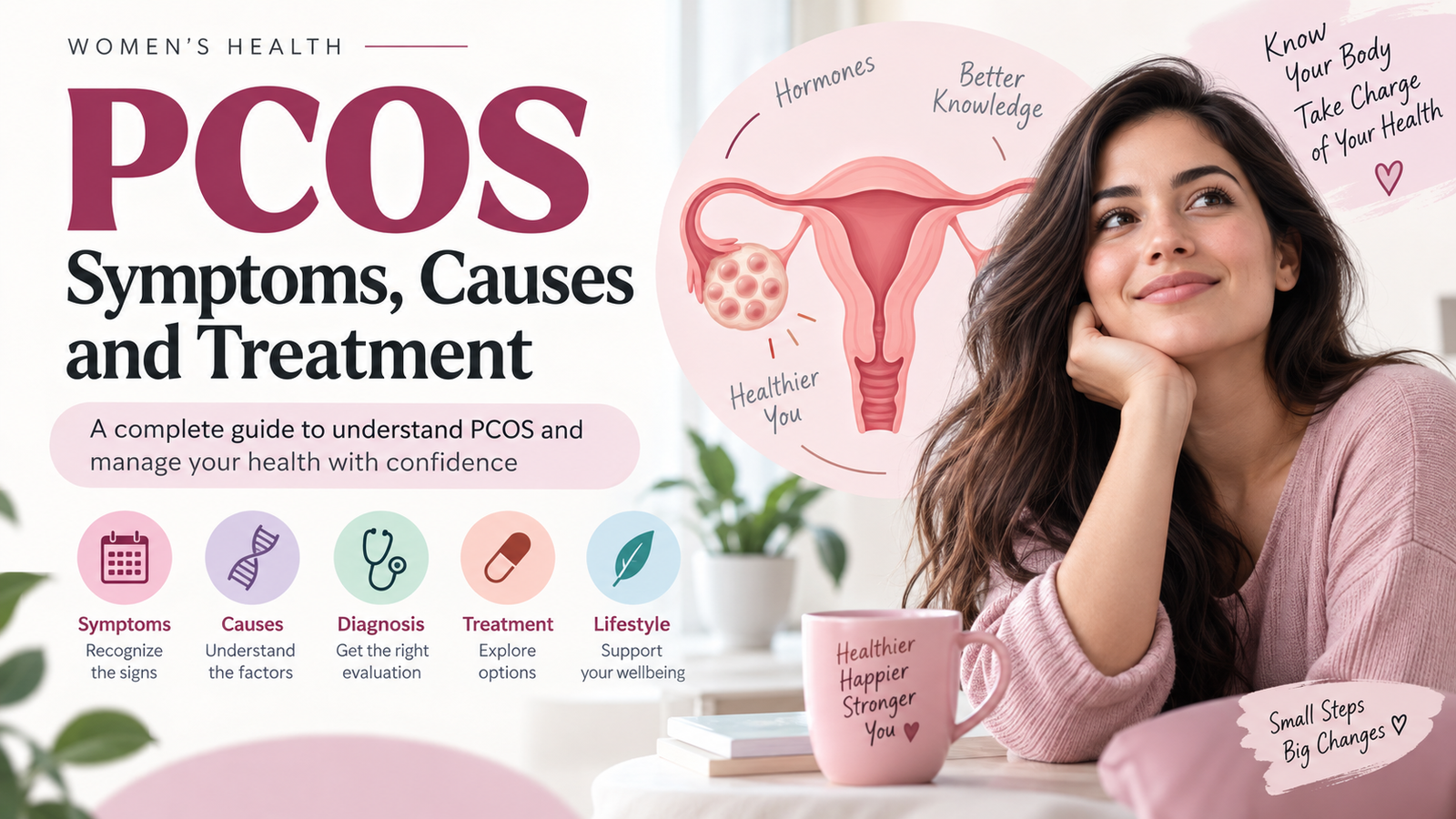
A practical guide to understanding PCOS symptoms, causes, diagnosis, treatment, fertility, lifestyle changes and long-term health in simple language.
Medical note: This article is for general education. PCOS symptoms can overlap with other health conditions, so diagnosis and treatment should be discussed with a qualified healthcare professional.
Polycystic ovary syndrome (PCOS) is a common hormonal and metabolic condition that can affect periods, ovulation, skin, hair, weight, fertility, and long-term health.
One of the confusing things about PCOS is that it does not look the same in everyone. Some women mainly notice irregular periods. Others may struggle with acne, unwanted facial hair, hair thinning, weight changes, or difficulty becoming pregnant. Some have several symptoms, while others have very few noticeable signs.
The good news is that PCOS can be managed. Treatment is not about following one “perfect PCOS diet” or taking one universal medicine. The right approach depends on your symptoms, health risks, pregnancy plans, and personal needs.
This guide explains PCOS symptoms, causes, diagnosis, treatment options, lifestyle changes, fertility, and when to see a doctor in simple language.
PCOS stands for polycystic ovary syndrome. It is a hormonal condition associated with problems with ovulation, higher androgen activity, and metabolic changes.
PCOS is common among people of reproductive age. The condition can affect periods, ovulation, fertility, skin, hair, metabolism, emotional wellbeing and pregnancy health.
Despite the name, having “cysts” on the ovaries is not necessary to have PCOS.
PCOS can continue beyond the reproductive years, which is why long-term health monitoring can be important.
PCOS symptoms can vary considerably from one person to another. Common symptoms include:
Periods may happen less often than expected, become unpredictable, or stop for several months.
Some people may also experience heavy or prolonged bleeding when periods occur.
Higher androgen activity can cause unwanted hair growth on areas such as the face, chin, upper lip, chest and abdomen.
This is known medically as hirsutism.
PCOS can be associated with increased androgen activity, which may contribute to persistent acne and oily skin.
Acne alone is not enough to diagnose PCOS.
Some women experience thinning of scalp hair, particularly around the crown or front of the scalp.
This can resemble female-pattern hair loss and may be associated with androgen excess.
PCOS can interfere with regular ovulation. Because ovulation may happen less frequently or unpredictably, some women with PCOS take longer to become pregnant.
Some people with PCOS experience weight gain or find weight management more challenging.
However, PCOS can occur at any body size.
Some people with insulin resistance develop darker, thicker, velvety areas of skin, particularly around the neck, armpits or groin.
This is called acanthosis nigricans.
There is no single known cause of PCOS.
Researchers believe that several factors can contribute, including genetics, hormone regulation, insulin-related metabolic changes, and other biological factors.
PCOS can run in families. Having a close family history of PCOS or type 2 diabetes may increase the likelihood of developing the condition.
Insulin is a hormone that helps move glucose from the bloodstream into cells. When the body becomes less responsive to insulin, the pancreas may produce more insulin to compensate.
Androgens are often called “male hormones,” but women naturally produce them too.
Higher-than-expected androgen levels or signs of androgen excess can contribute to unwanted facial or body hair, acne, scalp hair thinning and ovulation problems.
No.
PCOS is not simply caused by being overweight.
People with different body sizes can develop PCOS. At the same time, excess weight can affect metabolic health and may make some PCOS-related problems more difficult to manage.
Treatment should therefore focus on the person’s overall health rather than judging health by appearance alone.
Healthy eating, physical activity, sleep, emotional wellbeing, and appropriate medical care can all be part of PCOS management.
There is no single blood test that can confirm PCOS in every person.
Doctors usually look at the overall picture, including:
In adults, international guidance generally uses two of three features for diagnosis after other causes have been excluded:
Yes. The name can be misleading.
A person can meet diagnostic criteria for PCOS without having the typical ovarian appearance on ultrasound.
Likewise, seeing multiple follicles on an ultrasound does not automatically mean someone has PCOS.
Depending on your symptoms and medical history, a doctor may consider:
Important: Do not order a large panel of hormone tests on your own. A doctor can determine which tests are actually useful for your symptoms.
There is currently no single treatment that permanently removes PCOS.
Instead, treatment focuses on controlling symptoms, protecting long-term health, improving quality of life, and supporting fertility when pregnancy is desired.
The best treatment depends on what matters most to you.
Healthy lifestyle habits are an important part of PCOS management. This does not mean you need to follow an extreme diet.
You do not necessarily need to completely remove carbohydrates.
Exercise can support cardiovascular health, blood sugar regulation, fitness, mood, sleep and weight management when weight loss is appropriate.
Walking, cycling, swimming, strength training, yoga, dancing, or other activities can be useful.
The best exercise is often the one you can realistically continue.
Doctors may prescribe hormonal contraception, including combined oral contraceptive pills, when appropriate.
These medicines can help regulate menstrual bleeding and may also improve androgen-related symptoms such as acne or unwanted hair growth.
They are not suitable for everyone, so your medical history and individual risks need to be considered.
Metformin is a medicine commonly used for type 2 diabetes and is also used in some people with PCOS.
It may be considered particularly when metabolic problems such as insulin resistance, impaired glucose regulation, or increased diabetes risk are concerns.
Important: Metformin is not a universal PCOS medicine and should be used according to individual medical circumstances.
Unwanted facial or body hair can be emotionally difficult.
Anti-androgen medicines require appropriate medical supervision and effective contraception when pregnancy is possible.
Having PCOS does not mean you cannot become pregnant.
Many women with PCOS become pregnant naturally or with medical assistance.
If pregnancy is the goal, treatment changes. The focus may shift from controlling acne or regulating periods to helping achieve regular ovulation.
For infertility caused by anovulation associated with PCOS, the international guideline identifies letrozole as the preferred first-line pharmacological ovulation-induction treatment when there are no other infertility factors that change management.
Other fertility treatments may be considered if first-line treatment is unsuccessful or if additional fertility factors are present.
If you have PCOS and become pregnant, tell your obstetrician or healthcare provider about your diagnosis.
PCOS is associated with increased risks of some pregnancy complications, including gestational diabetes and high blood pressure disorders.
This does not mean that pregnancy will be unhealthy. It means appropriate prenatal care and monitoring are important.
PCOS is not only a reproductive or hormonal condition.
It can affect how a person feels about their body, relationships, fertility, appearance, and everyday life.
If PCOS is affecting your mood or daily life, mention it to your healthcare professional.
Mental health support is a legitimate part of PCOS treatment— not an afterthought.
PCOS can be associated with an increased risk of several longer-term health problems.
The level of risk varies between individuals and depends on factors such as metabolic health, age, symptoms, and other medical conditions.
This is one reason PCOS should not be treated only as a “period problem.”
There is currently no permanent cure for PCOS.
But that does not mean you have to live with uncontrolled symptoms.
With the right combination of lifestyle measures, medical treatment, fertility care when needed, and long-term monitoring, many people with PCOS can manage their symptoms and maintain good health.
Treatment may also change throughout life.
Not necessarily. Ovarian cysts are not required for a diagnosis of PCOS.
False. PCOS can affect people at different body sizes.
False. PCOS can make ovulation irregular, but many women with PCOS become pregnant naturally or with fertility treatment.
Not necessarily. There is no single diet that has been proven to be the best diet for every person with PCOS.
No. Hormonal contraceptives can help manage certain symptoms, particularly irregular periods and androgen-related symptoms, but they do not permanently cure the underlying condition.
Consider speaking with a gynecologist, endocrinologist, or primary healthcare professional if you have:
Seek medical advice promptly for unusually heavy bleeding, severe pelvic pain, fainting, or other symptoms that feel urgent or significantly different from your normal pattern.
You do not have to change everything at once. Start with realistic habits:
Small, sustainable changes are usually easier to maintain than extreme short-term programs.
Irregular periods are one of the most common signs, but PCOS can also present with acne, unwanted hair growth, scalp hair thinning, metabolic problems, or difficulty becoming pregnant.
There is no single first symptom that everyone experiences.
PCOS is generally considered a long-term condition. Symptoms can change over time and may become easier to manage, but there is no guaranteed natural cure.
Yes. PCOS does not automatically prevent pregnancy. Some women conceive without treatment, while others may need medication or fertility treatment to help with ovulation.
No. Some people with PCOS gain weight or have difficulty managing weight, while others do not.
PCOS can cause infertility when irregular or absent ovulation makes conception difficult. However, fertility treatment can help many women with PCOS.
PCOS is manageable, but it can be associated with longer-term metabolic, cardiovascular, reproductive, and psychological health concerns. Appropriate monitoring can help identify and manage these risks.
A gynecologist can evaluate menstrual, reproductive, and hormonal symptoms. Depending on your symptoms, an endocrinologist, fertility specialist, dietitian, dermatologist, or mental health professional may also be involved.
There is no single best treatment for everyone.
Treatment should be based on your symptoms, metabolic health, age, pregnancy plans, medical history, and personal preferences.
PCOS can be frustrating because the symptoms are not always obvious, and the condition can affect much more than your menstrual cycle.
But a PCOS diagnosis does not define your future health or fertility.
The most useful approach is to understand what your body is telling you, get an appropriate medical assessment, and create a treatment plan that fits your individual needs.
You do not need to follow every PCOS trend on social media.
You do not need an extreme diet.
And you do not need to manage everything alone.
If your periods are consistently irregular, you are experiencing signs of androgen excess, or you are having difficulty becoming pregnant, talk with a qualified healthcare professional.
Early evaluation can help you understand what is happening and decide what needs attention now—and what should simply be monitored over time.
This article is designed to provide clear, educational information about PCOS and help readers understand common symptoms, diagnosis and treatment options.
This article is intended to be based on established medical guidance and reputable health organizations.
Medical Disclaimer: This article provides general health information for educational purposes only. It does not diagnose PCOS or replace an examination, diagnosis, or treatment plan from a qualified healthcare professional.
Understanding your symptoms is an important first step. If you are concerned about irregular periods, fertility, hormonal symptoms or other changes, speak with a qualified healthcare professional.
Better information • Better conversations • Better health